

How to Build a Business Succession Plan in Five Steps
A business succession plan answers two questions before a transition forces them: who will run the business, and who will own it? Those answers may involve different people. A useful plan also sets out how an ownership interest can transfer, how a buyout will be paid for, and how the business documents fit with your estate plan.
For an Illinois business owner, the right documents depend on the company’s structure, its existing agreements, and the kind of transition you want. These five steps give you a practical order for making those decisions.
The five decisions are connected. Your goal guides the choice of leader and owner. Those choices shape the transfer terms, which must be affordable and consistent with your estate plan. The diagram shows that planning sequence; an actual transition may happen over time, and some decisions will need to be revisited together.
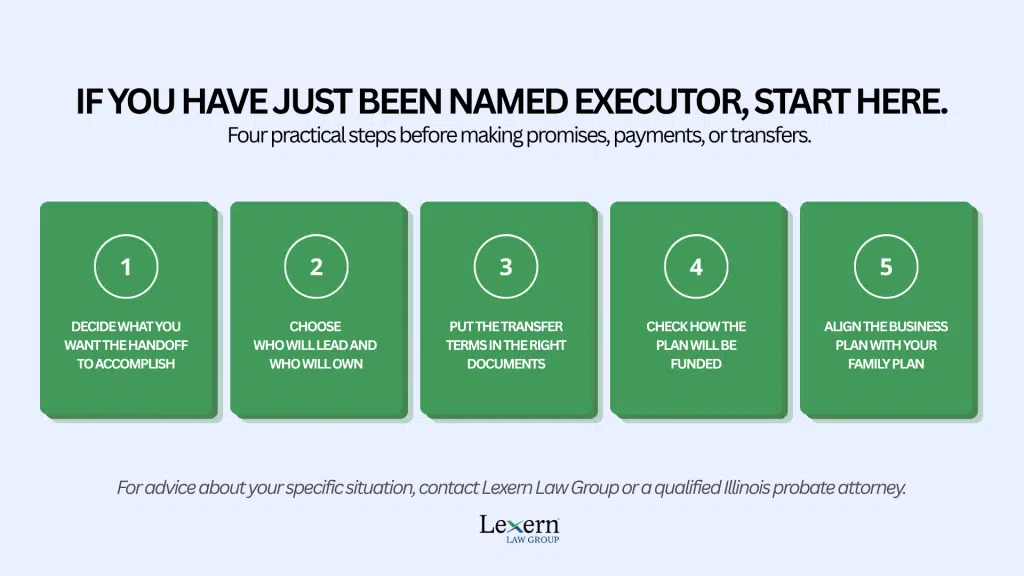
The five planning decisions, from the intended outcome to the documents that carry it out.
1. Decide what you want the handoff to accomplish
Start with the outcome, rather than a form or a proposed successor. You might want to retire gradually, sell to an outside buyer, transfer ownership to a family member, or leave the business to a partner. You might also want a family member to receive the financial value of your interest without taking responsibility for daily operations.
Write down your priorities. When do you expect to step away? Do you want to remain involved for a time? Is there someone willing and able to take over? What income will you need from the transfer? If you own the business with others, discuss what each owner expects to happen on retirement, disability, death, or a decision to leave.
You should also plan for an unexpected absence. A long-term exit plan does little for the next few weeks if no one knows who may make operational decisions while you are unavailable.
2. Choose who will lead and who will own
Leadership and ownership are separate decisions. A capable employee may be ready to manage staff and customers but unable to purchase the company. A family member may inherit an ownership interest but have no interest in running the business.
Identify the responsibilities your next leader would need to assume, including authority over employees, finances, key relationships, and decisions that currently depend on you. Then give that person a realistic opportunity to learn the work. Document who can act during a temporary absence and who should be contacted first.
For ownership, consider whether the interest will go to a family member, another owner, an employee, or an outside buyer. Confirm that the proposed recipient wants the role and can meet any conditions in the company’s agreements. If you own an Illinois LLC, transferring a right to receive distributions does not, by itself, give the recipient membership or management rights. The Illinois Limited Liability Company Act’s transfer provisions make that distinction especially relevant when choosing a successor.
3. Put the transfer terms in the right documents
Once the intended path is clear, review the company’s operating agreement, shareholder agreement, bylaws, buy-sell agreement, and ownership records, as applicable. The documents should answer:
- What events give someone an option or obligation to buy an interest?
- Who may buy it, and whose consent is needed?
- How will the interest be valued, and when will that value be determined?
- When and how must the purchase price be paid?
- Who has authority to run the business while a transfer is pending?
The answers must work together. For example, a will may leave an interest to a child, while a company agreement may restrict its transfer or limit the child’s role in management. Under the Illinois LLC Act, an operating agreement can govern relationships among members, managers, and the company. Illinois corporate share transfers may also be subject to restrictions under the Business Corporation Act. The company’s actual documents need to be reviewed before deciding what a transfer will accomplish.
4. Check how the plan will be funded
A purchase obligation needs a workable source of funds. Depending on the business and its owners, possibilities include available cash, financing, installment payments, life or disability insurance, or a combination. Each has costs and practical limits.
Test the plan against a straightforward question: if a transfer were triggered now, could the buyer or business make the payments the documents require while continuing to operate? Discuss valuation, cash flow, insurance terms, and potential tax consequences with the appropriate legal, financial, and tax advisers. Do not assume a policy or a future sale will provide the amount needed without checking it.
5. Align the business plan with your family plan
Your estate documents and business agreements should describe a compatible result. Review your will or trust, powers of attorney, fiduciary appointments, beneficiary designations, insurance arrangements, and ownership records alongside the company’s transfer provisions.
Consider what your spouse or other family members would receive, who could act if you became unable to manage your affairs, and what the remaining owners would be required to do. An ownership interest can affect a family’s finances even when a family member will never run the company.
Lexern’s business succession planning service describes how ownership, leadership, and financing fit together. Its business law service also covers the agreements used during a transition.
Where to start
Gather your current operating agreement or bylaws, any buy-sell or shareholder agreement, ownership records, relevant insurance policies, and estate planning documents. Note any outdated names, conflicting instructions, missing decision makers, or payment terms the business may struggle to meet.
If you want advice based on your company and goals, contact Lexern Law Group to discuss a review of the documents and the decisions still to be made.
This article provides general information, not legal or tax advice. Reading it does not create an attorney-client relationship.

Protect What You’ve Built. Plan for What’s Next.
Talk with Lexern Law Group about your estate, business, or succession-planning goals.
Speak With Our Team
Illinois: (847) 777-6838
Wisconsin: (414) 810-7070
Florida: (754) 444-7980