
How to Avoid Wisconsin Probate without Losing Control of Your Family Legacy
Key Takeaways on Avoiding Wisconsin Probate
-
Probate Threshold: In Wisconsin, any estate with more than $50,000 in probate-eligible assets must go through the formal court probate process.
-
The Control Factor: Tools like Revocable Living Trusts and Transfer on Death (TOD) Deeds allow you to bypass court completely without forfeiting your right to sell, alter, or refinance your property while you are alive.
-
The Trap of Joint Tenancy: Adding children to a deed to avoid probate exposes your home to their personal debts, divorces, and tax liens immediately.
-
Comprehensive Alignment: Avoiding court requires more than just a deed; your bank accounts, business entities, and personal property must be systematically coordinated to prevent partial probate.
The Real Cost of Wisconsin Probate Court
The baseline rule in Wisconsin is clear: if an individual passes away owning real estate or personal assets valued at a combined total greater than $50,000 in their individual name, those assets are frozen. They cannot be transferred to heirs until a probate judge signs off.
For most families, probate presents three distinct challenges:
-
Time Delays: A typical, uncontested Wisconsin probate takes anywhere from six months to over a year to fully close. During this window, real estate can be difficult to sell or manage efficiently.
-
Public Exposure: Probate is a matter of public record. Your debt levels, asset values, and the identities of your beneficiaries are accessible to anyone who searches the county court files.
-
Mandatory Costs: Between filing fees, statutory executor fees, and legal expenses, probate can drain thousands of dollars directly out of the legacy you intended for your family.
Fortunately, how to avoid Wisconsin probate does not require complex corporate shielding or losing your rights as a property owner.
Tools for How to Avoid Wisconsin Probate
Tool 1: The Wisconsin Transfer on Death (TOD) Deed
Governed by Wisconsin Statute § 705.15, a Transfer on Death (TOD) Deed is a legal document recorded with your county’s Register of Deeds. It explicitly designates who will inherit your real estate automatically upon your passing.
The fundamental advantage of a TOD deed is that it conveys absolutely no current interest to your beneficiary while you are living.
Benefits of a Wisconsin TOD Deed
-
Absolute Control: You retain the unilateral right to sell the property, take out a mortgage, or revoke the TOD designation entirely at any point. Your beneficiaries have no say in what you do with the home.
-
Zero Court Involvement: When you pass away, the beneficiary simply records an administrative form (Form TOD-110) along with a certified copy of the death certificate. The title shifts to them automatically, completely bypassing probate.
-
Low Cost: It is one of the most cost-effective methods to protect a primary residence from court intervention.
Disadvantages of a Wisconsin TOD Deed
While highly effective for single pieces of real estate, a TOD deed is a rigid tool for how to avoid Wisconsin probate. If a named beneficiary passes away before you do, or if you name multiple beneficiaries who cannot agree on whether to sell or keep the home, the property can quickly fall back into legal disputes or forced partition lawsuits.
Tool 2: The Wisconsin Revocable Living Trust
A Revocable Living Trust is a comprehensive legal entity built to hold ownership of your assets during your lifetime, manage them if you become incapacitated, and distribute them privately upon your death. A Revocable Living Trust can be an essential tool for how to avoid Wisconsin probate.
Under this structure, you act as the Grantor (the creator), the Trustee (the manager), and the Primary Beneficiary (the recipient of the benefits).
Benefits of a Wisconsin Revocable Living Trust
-
Total Control and Continuity: Because you are the Trustee, you manage your properties, accounts, and investments exactly as you did before. If you want to sell an asset, you sell it. If you want to modify the distribution rules, you amend the trust.
-
Asset Protection for Heirs: You can write specific rules governing how your family inherits wealth. Instead of handing a 21-year-old child a lump-sum inheritance, the trust can distribute funds gradually over time, protecting the legacy from future divorces or creditors.
-
Incapacity Planning: If a medical emergency leaves you unable to manage your affairs, your designated Successor Trustee steps in seamlessly to pay bills and manage properties without your family needing to petition a court for guardianship.
Disadvantages of a Wisconsin Revocable Living Trust
A trust requires a higher upfront financial investment to establish than a standalone deed. Furthermore, it only protects the assets that are explicitly transferred (“funded”) into it. If you build a trust but leave your primary real estate titled in your individual name, that property will still be subject to Wisconsin probate and doesn’t solve how to avoid Wisconsin probate.
The Hidden Risks of “Simple” Probate Fixes
Many asset owners attempt to sidestep the cost of professional estate planning by utilizing “do-it-yourself” methods. In Wisconsin, these shortcuts regularly backfire, creating severe financial exposure.
The Quitclaim Trap: A common error is quitclaiming a portion of your home to a child to establish joint tenancy. The moment their name hits the deed, you lose unilateral control. You cannot sell or refinance the home without their signature. Worse, if your child faces a lawsuit, a tax lien, or a messy divorce, their creditors can place a lien directly against your home.
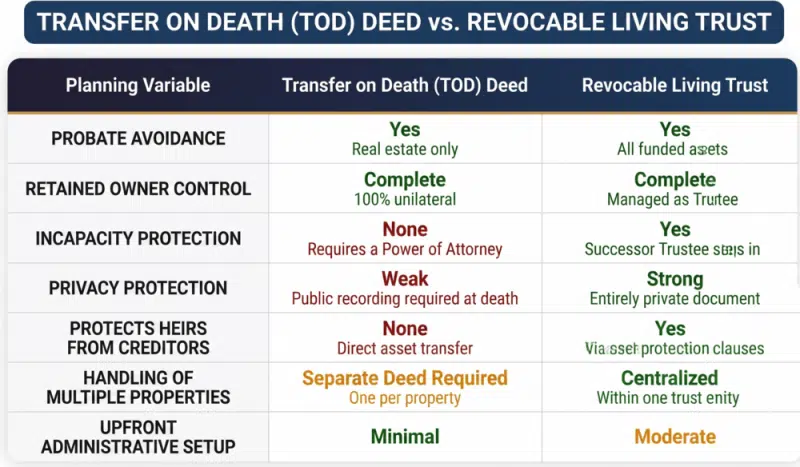
Comparison Map: TOD Deed vs. Revocable Living Trust
To assist in determining which tool aligns with your specific family dynamic, review how these structures handle asset management, privacy, and protection under Wisconsin law:
Frequently Asked Questions
Does avoiding probate reduce my Wisconsin estate or inheritance taxes?
Wisconsin repealed its state estate tax and does not have a state inheritance tax. Avoiding probate does not alter your federal estate tax position (which features a high exemption threshold), but it saves your estate from the standard administrative costs and court fees associated with probate.
Can I sell my house if it has a Wisconsin TOD deed recorded against it?
Yes. A TOD deed does not limit your current ownership privileges. You can sell, modify, or encumber the property at any time without notifying or obtaining consent from the designated beneficiaries.
What happens if I buy new property after creating a Revocable Living Trust?
Any new real estate or investment assets acquired must be titled directly in the name of the trust to maintain probate protection. Leaving new acquisitions in your individual name will expose those specific assets to court intervention if your remaining individual estate exceeds $50,000.
Why Coordinate Your Legacy with an Estate Planning Attorney
How to avoid Wisconsin probate is not simply about signing a single document; it is about establishing a coordinated system where your real estate, financial portfolios, and personal assets move together seamlessly. A flaw in a single title or an uncoordinated beneficiary designation can derail an entire legacy strategy.
At Lexern, we construct tailored estate frameworks that prioritize your absolute control over your wealth today, while building an ironclad boundary around your family’s future inheritance.
Ready to secure your family legacy without sacrificing control? Contact Lexern today to map out a clear, probate-free future for your estate.
This article is intended to serve as a general summary of the issues outlined therein. While this article may include general guidance, it is not intended as, nor is a substitute for, qualified legal advice. Your review or receipt of this article by Lexern Law Offices, Ltd. (the “LLG”) or any of its attorneys does not create an attorney-client relationship between you and the LLG. The opinions expressed in this article are those of the authors of the article and do not reflect the opinion of the LLG. Please note that this article may have been generated using AI technology.